Features
Less snow at 124 of 125 stations: snowfall near Japan's ski resorts is down 30% in the last decade
Text and data: JAPOW NOW Data Lab
Has the snow at Japan's ski resorts decreased over the last 40 years?
The answer: yes, it has.
So by how much? We took 125 Japan Meteorological Agency (JMA) AMeDAS stations near ski resorts and compared the total snowfall of each season (the sum of daily snowfall) for 40 seasons, from 1986-87 to 2025-26.
Snowfall in the last 10 years (2016-17 to 2025-26) was 69, taking the first 10 years (1986-87 to 1995-96) as 100. That is roughly 30% less.
One example is Sapporo Teine and Sapporo Kokusai (AMeDAS station: Koganeyu). Between the first 10 years and the last 10 years, the average per season fell from 1,128 cm to 582 cm, down 48%.
But it hasn't been a steady 40-year decline. From the first 10 years to the next 10 years it went 100 → 102, almost flat.
In the 20 years since, it has kept falling: 85 → 69.
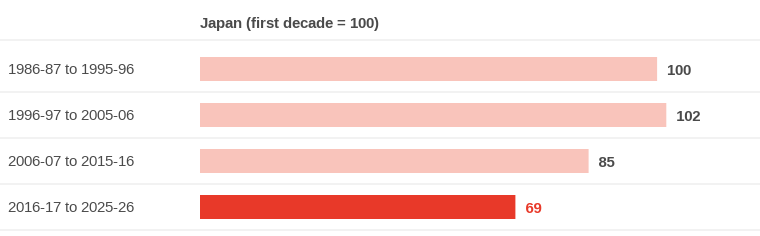
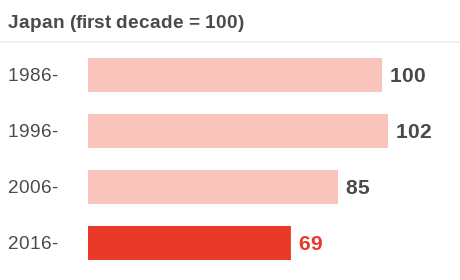
How the "Japan" figure works For each of the 125 stations, we set the first decade's average to 100 and calculated each decade against it. Then we lined up the 125 stations from smallest to largest and took the value of the station exactly in the middle (the 63rd). We use the middle value (the median) rather than the average so that stations with especially heavy or light snow don't pull the number. 69 means 31% less than the first decade.
Of the 125 stations, 124 got less snow in the last 20 years than in the first 20. The only one with more was Dorobu in Tochigi (near Hunter Mountain Shiobara). In other words, snowfall went down at 99% of the stations.
How the big-name areas changed
We compared average snowfall per season in the first 20 years (1986-87 to 2005-06) and the last 20 years (2006-07 to 2025-26), largest decline first.
| Ski resort (station) | First 20 years | Last 20 years | Change |
|---|---|---|---|
| Sapporo Kokusai, Sapporo Teine and others (Koganeyu) | 981cm | 613cm | −37% |
| Rusutsu, Nakayama Toge (Kimobetsu) | 1,133cm | 745cm | −34% |
| Furano (Furano) | 693cm | 514cm | −26% |
| Arai Mountain Resort, Akakura Onsen and others (Sekiyama) | 1,159cm | 896cm | −23% |
| GALA Yuzawa, Kagura and others (Yuzawa, Niigata) | 1,149cm | 892cm | −22% |
| Niseko Moiwa (Rankoshi, west side of Niseko) | 818cm | 643cm | −21% |
| Kiroro (Akaigawa) | 1,009cm | 854cm | −15% |
| Nozawa Onsen, Ryuoo Ski Park and others (Nozawa Onsen) | 1,153cm | 975cm | −15% |
| Hakkoda (Sukayu) | 1,792cm | 1,540cm | −14% |
| Hakuba Happo-One, Hakuba 47 / Goryu and others (Hakuba) | 668cm | 575cm | −14% |
| Shiga Kogen Sun Valley, Shiga Kogen Maruike and others (Kusatsu, for reference) | 624cm | 606cm | −3% |
The Hakuba figures are measured in Hakuba village at the foot of the mountains (703 m). Snowfall higher up on Happo-One (the top is 1,831 m) is different. Kutchan, the station for Niseko, changed how it measures snow in 2005, so it can't be compared over 40 years; we used Rankoshi on the west side of Niseko (nearest to Niseko Moiwa) instead. Shiga Kogen has no AMeDAS station nearby, so the figures are from Kusatsu in Gunma.
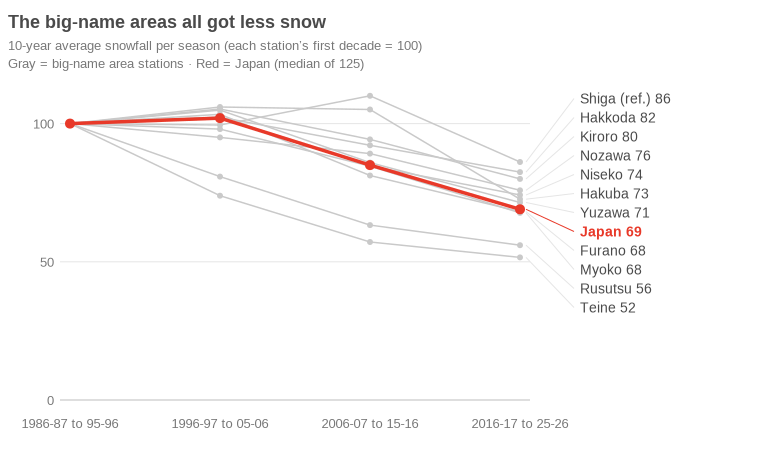
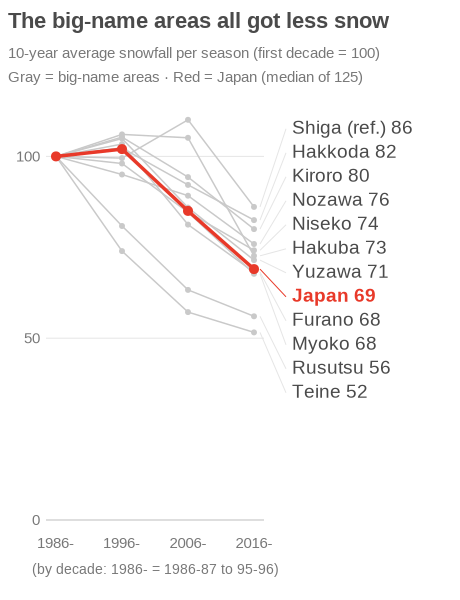
Stations Teine = Koganeyu, Rusutsu = Kimobetsu, Myoko = Sekiyama, Yuzawa = Yuzawa (Niigata), Niseko = Rankoshi, Kiroro = Akaigawa, Hakkoda = Sukayu, Shiga = Kusatsu (for reference).
Here are the stations for the big-name areas with the actual amounts by decade (10-year average of snowfall per season).
| Ski resort (station) | 1986-87 to 95-96 | 1996-97 to 05-06 | 2006-07 to 15-16 | 2016-17 to 25-26 |
|---|---|---|---|---|
| Sapporo Teine, Sapporo Kokusai and others (Koganeyu) | 1,128cm | 834cm | 645cm | 582cm |
| Rusutsu, Nakayama Toge (Kimobetsu) | 1,253cm | 1,013cm | 793cm | 702cm |
| Furano (Furano) | 682cm | 705cm | 554cm | 465cm |
| Arai Mountain Resort, Akakura Onsen and others (Sekiyama) | 1,170cm | 1,147cm | 990cm | 792cm |
| GALA Yuzawa, Kagura and others (Yuzawa, Niigata) | 1,122cm | 1,177cm | 964cm | 802cm |
| Hakuba Happo-One, Hakuba 47 / Goryu and others (Hakuba) | 647cm | 686cm | 680cm | 470cm |
| Niseko Moiwa (Rankoshi, west side of Niseko) | 809cm | 828cm | 685cm | 600cm |
| Nozawa Onsen, Ryuoo Ski Park and others (Nozawa Onsen) | 1,182cm | 1,123cm | 1,054cm | 897cm |
| Kiroro (Akaigawa) | 980cm | 1,032cm | 924cm | 784cm |
| Hakkoda (Sukayu) | 1,774cm | 1,815cm | 1,635cm | 1,463cm |
| Shiga Kogen Sun Valley, Shiga Kogen Maruike and others (Kusatsu, for reference) | 626cm | 623cm | 689cm | 539cm |
The 10 stations with the smallest decline
| Ski resort (station) | First 20 years | Last 20 years | Change |
|---|---|---|---|
| Hunter Mountain Shiobara, Edelweiss (Dorobu) | 338cm | 385cm | +14% |
| Shiga Kogen Sun Valley, Shiga Kogen Maruike and others (Kusatsu) | 624cm | 606cm | −3% |
| Geto Kogen, Jeunesse Kurikoma and others (Yuda) | 1,035cm | 999cm | −3% |
| Okunakayama Kogen (Okunakayama) | 572cm | 548cm | −4% |
| Hiroshima Kenmin no Mori, Dogoyama Kogen (Yokota) | 392cm | 372cm | −5% |
| Owani Onsen (Ikarigaseki) | 606cm | 576cm | −5% |
| Onikoube, Akakura Onsen (Yamagata) (Mukaimachi) | 795cm | 759cm | −5% |
| Ishikari Heigen (Shinshinotsu) | 825cm | 778cm | −6% |
| Hanagasa Kogen (Obanazawa) | 932cm | 866cm | −7% |
| Shirataka Town Ski Area, Nishikawa Chomin and others (Aterazawa) | 611cm | 560cm | −8% |
Six of the 10 stations with the smallest decline are in Tohoku (Yuda, Okunakayama, Ikarigaseki, Mukaimachi, Obanazawa and Aterazawa). Yuda, the station for Geto Kogen, still averaged 999 cm in the last 20 years, almost the same as before. The only station with more snow was Dorobu in Tochigi.
The 10 stations with the largest decline
| Ski resort (station) | First 20 years | Last 20 years | Change |
|---|---|---|---|
| Churui Hakugindai (Taiki) | 766cm | 366cm | −52% |
| Sahoro, Shintokuyama (Shintoku) | 671cm | 334cm | −50% |
| Okushiri Sakuragaoka (Kumaishi) | 591cm | 300cm | −49% |
| Unabetsu (Shari) | 681cm | 354cm | −48% |
| Ohana Resort (Kokkyo Kogen) (Yanagase) | 579cm | 309cm | −47% |
| Akan-kohan (Akankohan) | 665cm | 360cm | −46% |
| Biwako Valley, Biwako Hakodateyama and others (Imazu) | 305cm | 174cm | −43% |
| Kokusetsu Shimukappu Chuo (Shimukappu) | 876cm | 512cm | −42% |
| Anpeizan (Abira) | 496cm | 291cm | −41% |
| Kuzuryu, Fukui Izumi (Kuzuryu) | 973cm | 577cm | −41% |
On the other hand, seven of the 10 stations with the largest decline are in Hokkaido (Taiki, Shintoku, Kumaishi, Shari, Akankohan, Shimukappu and Abira). The other three are in Shiga and Fukui. All of them are down 41% to 52%. At Shintoku, the station for Sahoro, the average went from 671 cm in the first 20 years to 334 cm in the last 20. Even within Hokkaido, Rankoshi (Niseko Moiwa) is down only 21% and Akaigawa (Kiroro) only 15%.
Summary
Most of you probably already had a feeling that there's less snow at ski resorts.
What 40 years of data showed is, as expected, that the snow at ski resorts has decreased. Snowfall went down at 124 of the 125 stations, and the last 10 years had 30% less than 30 years earlier. The drop has been clear especially since around 2006.
The big-name areas are no exception. Teine and Rusutsu are down more than 30%, Myoko and Yuzawa a little over 20%, and Nozawa Onsen, Hakuba and Hakkoda a little over 10%.
But places with a lot of snow still get a lot of snow. Nozawa Onsen's average over the last 10 years, 897 cm, is more than the 647 cm that Hakuba village (at the foot of the mountains) got in the first 10 years, before the decline.
The snow has decreased. Even so, the snowy places are still the snowy places.
The JMA AMeDAS data behind this article, as cumulative snowfall and powder days for each ski resort, season by season, is in the powder days ranking.
How to read this
We used stations that had values for at least 7 seasons in each of the four decades, and an average of at least 200 cm in the first 20 years. We didn't use values from before a year in which JMA recorded a move of the station or a change of equipment. 2025-26 is not yet in JMA's annual tables, so it is the total for November to April.
JMA also reports a declining trend in annual maximum snow depth since 1962 (Climate Change in Japan 2025). However, snowfall varies a lot from year to year, and these numbers say nothing about how much snow next season will bring.
Source: JMA AMeDAS (annual tables, total snowfall) / analysis: Japow Now!